What if I told you there is a temple where a mystery is hidden inside the deity itself? A place where the top cooking pot finishes before the ones below it, where a flag appears to move against the wind, and where centuries-old stories continue to challenge everything we think we know.
Sounds like fiction?
It isn’t.
Every year, millions of devotees gather in Odisha during the Rath Yatra, hoping to catch a glimpse of Lord Jagannath. For many, it’s a journey of faith. For others, it’s a search for answers. Yet almost everyone returns with one realization: the deeper you explore Jagannath Puri, the more mysterious it becomes.
During an eye-opening conversation on Supertalks, host Raghav Sharma sat down with researcher Dr Surya Roy to explore some of the most fascinating Jagannath Puri Temple Mysteries. What unfolded wasn’t a debate between science and spirituality. It was a journey through history, ancient traditions, and questions that have remained unanswered for centuries.
Some mysteries have documented rituals behind them. Others are rooted in ancient scriptures and oral traditions. A few continue to puzzle historians, researchers, and devotees alike.
Let’s begin with perhaps the greatest mystery of them all.
Among all the mysteries surrounding the Jagannath Temple, none is discussed more than the mysterious object known as Brahma Padartha.
For centuries, people have tried to answer one question.
What exactly is hidden inside Lord Jagannath?
The truth is surprisingly simple.
No one knows.
Nobody has tried to find out, but the secret has been protected through one of Hinduism’s most sacred rituals.
During the podcast, Dr Surya Roy explained that Brahma Padartha is often called the “secret of all secrets.” Even among scholars, there is no universal agreement about what it actually is. Every explanation remains a theory because the ritual surrounding it is performed in complete secrecy.
That mystery has only made people’s curiosity grow stronger with time.
A Ritual That Happens Only Once in Several Years
Unlike most temple idols, the wooden deities of Lord Jagannath, Lord Balabhadra and Devi Subhadra are not permanent.
At specific intervals, traditionally every 8, 12 or 19 years, a sacred ceremony known as Navakalevara takes place.
The word itself means “new body.”
During this extraordinary ritual, new wooden deities are carved while the old ones are respectfully retired.
But something far more mysterious happens during this process.
A sacred element known as Brahma Padartha is transferred from the old deity into the new one.
The transfer takes place under extremely strict traditions. According to temple customs, the ritual is performed in complete darkness by a select group of priests who follow centuries-old procedures. The object itself is never publicly displayed.
Generation after generation, the mystery continues.
Is Brahma Padartha Really Lord Krishna’s Heart?
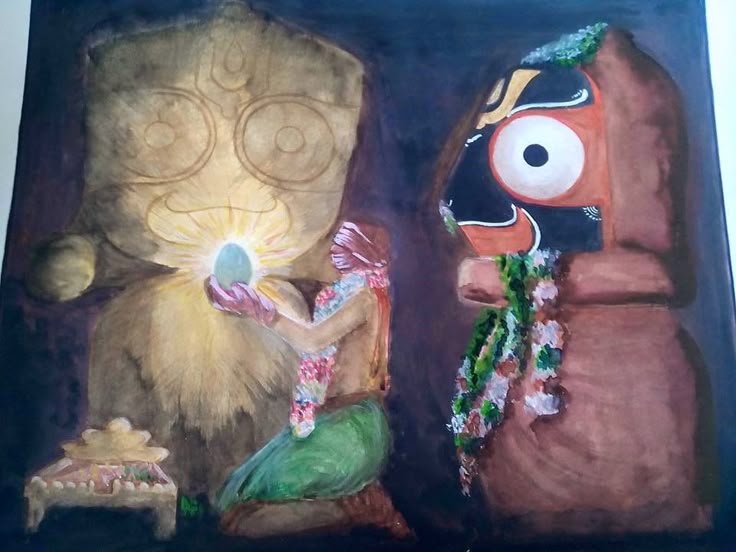
Perhaps the most popular belief connected with the Jagannath Temple is that Brahma Padartha is the heart of Lord Krishna.
It is a story that has fascinated devotees for generations.
When Raghav Sharma raised this question during the conversation, Dr Surya Roy responded with remarkable honesty.
He explained that there is no definitive answer.
Instead, he shared two traditional interpretations found in scriptures and long-standing beliefs.
The first connects Brahma Padartha with the concept of Daru Brahma, a sacred divine essence mentioned in the Atharvaveda.
The second is the belief that the sacred object could be the nabhi, or navel, of Lord Krishna.
According to this traditional account, after Lord Krishna left His earthly form, His body was cremated. Yet one part did not completely burn.
That sacred remnant is believed to have floated across the sea before reaching the coast of ancient Utkal, present-day Odisha.
There, it was eventually discovered by a tribal chief named Biswabasu, setting the stage for one of Hinduism’s most remarkable legends.
Whether one sees this as history, scripture, or sacred tradition, the story continues to inspire millions of devotees across the world.
The Story Begins Long Before the Jagannath Temple Existed
Long before the magnificent temple stood in Puri, devotion to the Lord was already alive.
According to the tradition shared by Dr Surya Roy, there once lived a devoted tribal chief named Biswabasu, who secretly worshipped a divine form known as Nilamadhav deep inside a forest.
The deity’s location was known only to him.
Far away in the kingdom of Avanti, King Indradyumna heard stories of this extraordinary form of Lord Vishnu.
Determined to find Him, the king sent a learned Brahmin named Vidyapati on what would become an unforgettable journey.
Finding Nilamadhav, however, was far from easy.
Biswabasu guarded the location with absolute secrecy.
According to the legend, Vidyapati eventually married Biswabasu’s daughter, Lalita.
Even then, the tribal chief agreed to take him to the sacred place only under one condition.
Vidyapati would be blindfolded throughout the journey.
It seemed impossible.
But Vidyapati came prepared.
As he walked through the forest, he quietly dropped mustard seeds along the path.
Weeks later, those seeds sprouted.
They became a natural trail leading back to the hidden shrine.
It is one of those ancient stories that feels almost cinematic, yet it remains deeply woven into the spiritual history of Jagannath.
When the Lord Chose a Different Form
King Indradyumna eventually arrived with his army, eager to witness Nilamadhav.
But the deity had disappeared.
Instead of disappointment, the king received a divine message.
According to the tradition narrated during the podcast, a heavenly voice told him not to search anymore.
The Lord would appear again.
Not as stone.
Not as metal.
But as Daru Brahma, a sacred wooden form emerging from the sea.
Soon after, a massive divine log is believed to have appeared at Chakratirtha.
No ordinary person could move it.
Only after prayers and complete surrender could the king bring it ashore.
What happened next became another mystery that continues to define the identity of Lord Jagannath.
An elderly carpenter appeared and offered to carve the deities.
His condition was unusual.
He would work alone.
The door must remain closed.
No one should disturb him for 21 days.
Days passed in silence.
Then came doubt.
The queen feared something terrible had happened inside.
Unable to wait any longer, the door was opened before the agreed time.
The carpenter had vanished.
Standing inside were the wooden forms of Lord Jagannath, Lord Balabhadra and Devi Subhadra.
Unlike any other deities in India, they appeared unfinished.
Their hands and legs were incomplete.
According to tradition, a divine voice declared that this was the form in which the Lord wished to be worshipped during the Kalyug.
Even today, these unique forms have become one of the most recognizable symbols of Jagannath devotion across the world.
And yet, that is only the beginning of the temple’s mysteries.
When Faith Speaks, Logic Quietly Steps Aside
After discussing hidden chambers, sacred rituals, mysterious traditions, and centuries-old legends, Raghav Sharma asked a simple question.
Can all of this really be explained?
For Dr Surya Roy, the answer wasn’t about choosing between science and spirituality.
It was about understanding their limits.
Throughout the conversation, he never suggested that every mystery should blindly be accepted without question.
Instead, he encouraged curiosity.
Research.
Observation.
And respect for traditions that have survived for centuries.
Some questions may eventually find historical or scientific explanations.
Others may continue to remain beyond our complete understanding.
That, perhaps, is what makes Jagannath Puri Temple Mysteries so fascinating.
The deeper you search for answers, the more questions begin to appear.
A Rath Yatra Experience That Stayed With Dr Surya Roy Forever
As the podcast drew towards its conclusion, Dr Surya Roy shared a deeply personal memory from the Rath Yatra.
It wasn’t about history.
It wasn’t about archaeology.
It was simply an experience that left a lasting impact on him.
He recalled attending the Rath Yatra in 2013.
The weather was unforgiving.
Lakhs of devotees stood beneath the scorching summer sun, waiting patiently for a glimpse of Lord Jagannath.
Looking at the crowd, he silently prayed.
His prayer wasn’t for himself.
It was for the devotees who had travelled from different parts of the country, standing for hours in the intense heat with unwavering faith.
According to him, something unexpected happened soon after.
Within about half an hour, dark clouds gathered over Puri.
Then it began to rain heavily.
For many people, rain is simply part of nature.
For many devotees present that day, it felt like divine compassion.
Dr Surya Roy didn’t present the incident as scientific proof.
He simply shared it as an experience that strengthened his own faith.
It became another reminder that not every moment of life can be measured only through logic.
Can Science Explain Every Mystery?
Science has helped humanity answer countless questions.
It has transformed medicine, technology, astronomy and our understanding of the universe.
But every civilisation also carries traditions that cannot always be understood through laboratory experiments alone.
The Jagannath Temple stands at that unique intersection.
Its mysteries invite investigation.
Its history encourages research.
Its rituals preserve ancient knowledge.
And its spiritual significance continues to inspire millions of people every year.
Whether someone visits as a devotee, a traveller, a historian or simply a curious observer, they often leave with the same feeling.
Jagannath Puri is not just a destination.
It is an experience.
One that refuses to fit neatly into a single explanation.
More Than a Temple, It Is a Living Tradition
Perhaps that is why Lord Jagannath has remained at the heart of Indian civilisation for centuries.
The temple is not famous only because of its magnificent architecture.
Nor only because of the grand Rath Yatra that attracts millions of devotees from around the world.
Its true power lies in the stories that continue to live through every ritual, every tradition and every generation that passes them forward.
The mystery of Brahma Padartha.
The legend of Daru Brahma.
The possibility of hidden structures beneath the sacred city.
The remarkable temple kitchen.
The ever changing flag.
The majestic Nilachakra.
Each story offers a different perspective.
Some are supported by documented rituals.
Some come from ancient scriptures.
Some survive through oral traditions passed from one generation to another.
Together, they form the timeless identity of Jagannath Puri.
Watch the Complete Conversation on Supertalks
This article captures some of the most fascinating moments from the conversation between Raghav Sharma and Dr Surya Roy.
But like every great conversation, there is far more depth than words alone can capture.
Throughout the episode, Dr Surya Roy shares historical references, scriptural insights and personal experiences that offer a unique perspective on the mysteries surrounding Lord Jagannath and the sacred city of Puri.
If these stories sparked your curiosity, the complete episode is well worth watching.
You’ll discover not just facts, but the emotion, context, and deeper discussions that make the conversation truly unforgettable.
Because sometimes, listening to a story is very different from experiencing it.
And when the story is about Lord Jagannath, every answer seems to lead to an even greater mystery.
Jay Jagannath.